
Annota brings academic writing support in-house
A tool that started as a side project in LabNext70 could deliver considerable annual savings for UNE.
Annota is an AI-powered academic writing feedback platform built to replace Studiosity, giving UNE greater control over how students receive formative writing support, where their data is stored and what that feedback is grounded in.
The platform was developed alongside a broader effort across UNE to explore alternatives to the existing service, with a number of teams working on potential solutions. Shannon Tyrrell initially developed Annota as a LabNext70 side project, with AI Capability Engineer Tom Miles developing key technical infrastructure, while Education Futures was progressing its own work on an in-house approach to academic writing support.
Those two streams of work have since come together to shape Annota for UNE, combining LabNext70’s technical innovation with Education Futures’ educational design and academic skills expertise.
“We're taking a function we already offer through a third-party service and bringing it in-house, using resources developed by our own academics, so the feedback is grounded in how we actually teach and support students at UNE,” says Shannon Tyrrell, AI Innovation Lead at LabNext70.
Annota is designed to help students improve their own writing, rather than do the work for them. Students receive formative feedback on draft assessments across five areas: critical thinking, structure and organisation, language and tone, spelling and grammar, and referencing. Feedback is anchored directly to relevant passages in their work, explaining what could be improved and guiding students through the revision process without rewriting their text for them.
As LabNext70 and Education Futures have worked together to shape Annota for UNE, the two teams have brought complementary expertise to the platform. One outcome of that collaboration is the ability to flag potential gaps between assessment instruction and a student’s draft, such as a required component that appears to be missing or a submission that falls well short of the expected word count.
Grounded in UNE's own academic guidance
Bringing the service in-house means UNE can draw on the Academic Skills Office's deep understanding of UNE students, including their backgrounds, their learning needs, and the writing challenges they commonly face, to shape feedback that is genuinely relevant. Huifang Li from the Academic Skills Office reflects on what that means in practice.
“AI can provide feedback quickly and at scale, as some external providers do, but meaningful feedback starts with understanding students. This collaboration provides the opportunity to bring ASO’s expertise in academic literacies and our understanding of UNE students into a tool designed for the UNE context. Together, we can make a real difference to the learning experience of more students.”
“We teach students that responsible use of AI means not simply accepting what it tells you, but checking the information against reliable sources. Annota brings that full circle. The feedback is grounded in UNE’s own academic resources, and students can go back to those sources themselves to understand the guidance and verify what the AI is telling them,” Shannon says.
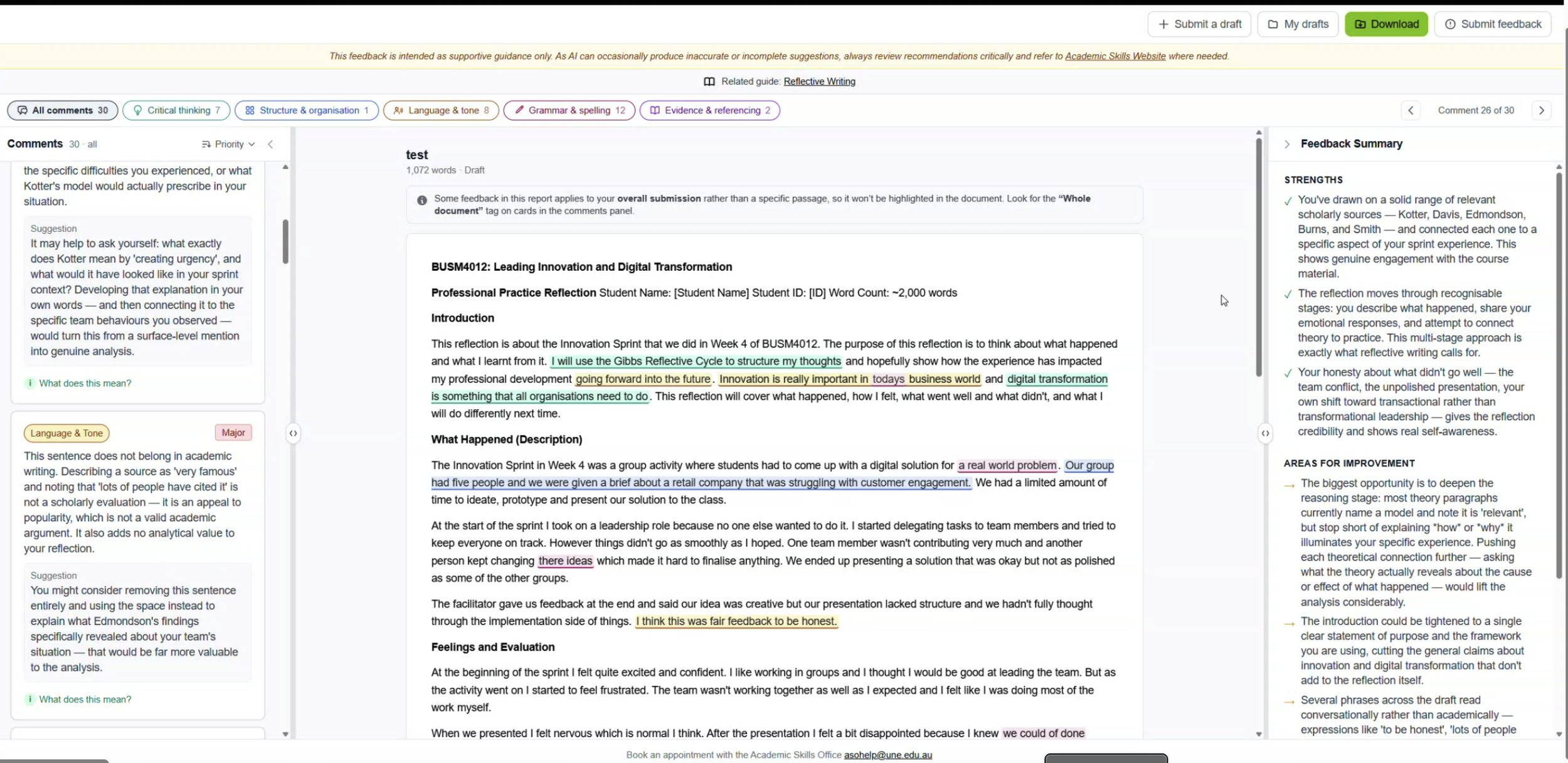
Example of Annota’s user interface.
Protecting student work
Data governance has also been central to Annota’s development. The platform is being designed to operate within a sovereign UNE-controlled environment, and the team is working closely with relevant technical and governance groups across the University to ensure this is implemented appropriately. This approach means student drafts can be processed within UNE’s governed systems rather than being sent to a separate external AI service.
Just as importantly, students retain control of the work they submit. Annota does not claim ownership or ongoing rights over student submissions, and their work is not used to train AI models.
“Students shouldn't have to give away rights to their work just to receive feedback on it,” Shannon says. “Their work remains their work. We're protecting it, not using it to train models or claiming rights over it.”
From side project to UNE platform
Annota began as a small LabNext70 side project exploring what an in-house approach to AI-supported academic writing feedback could look like. What started as an experiment has since developed into a platform being prepared for broader student use.
The financial difference is significant. Replacing the existing external service with Annota is expected to deliver considerable annual savings for UNE, with the platform’s ongoing AI processing costs representing only a fraction of the existing expenditure.
“It started as a little side project to see whether we could do this differently,” Shannon says. “Once we could see what was possible, it became much bigger than that.”
Shaping Annota for UNE
LabNext70 and Education Futures are now working together to prepare Annota for student use, testing and refining the quality, structure and presentation of Annota’s feedback.
The next stage will put Annota into the hands of UNE staff for testing, before extending testing to a student group. Feedback from both groups will help shape the platform ahead of the broader student rollout.
Staff and students interested in taking part in Annota testing are invited to register their interest.