Media
LabNext70 continues to drive innovation by developing AI-driven solutions that enhance the learning experience for our students, assist academics, and empower our staff, with all media and news inquiries directed to our dedicated communications team.
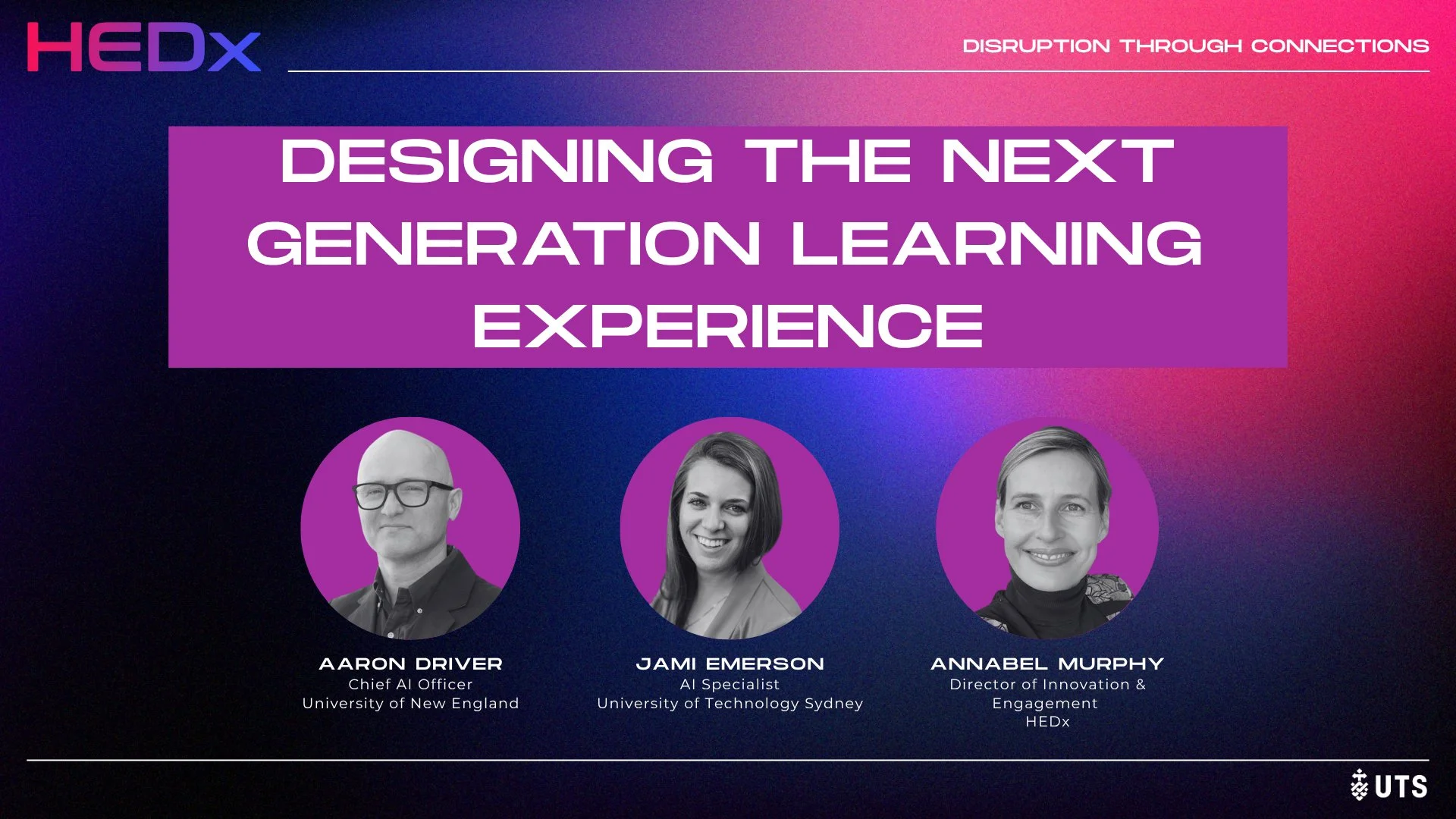
UNE's Chief AI Officer Aaron Driver and AI Innovation Lead Shannon Tyrrell took Madgwick Studio to the HEDx Conference at UTS Sydney on 17 June. Presenting alongside UTS AI Specialist Jami Emerson and HEDx Director of Innovation and Engagement Annabel Murphy, the session 'Designing the next-generation learning experience' had participants design a lesson in real time - with the strongest concept built on the spot and tested from the student side.
____
The newest addition to UNE's Madgwick suite, Studio is a platform where students reason, explain and prove what they know as they learn. In a world where polished outputs can be produced without underlying understanding, Studio ensures capability is genuinely earned. Around Studio, the Madgwick ecosystem is growing. Studio is a Learning Experience Engine where students prove capability. Earned Learning is the pedagogy behind it.
____
The Industry Engagement Discovery Tool, developed by Kyle Mulrooney from the Humanities, Arts and Social Sciences faculty with support from LabNext70, addresses a persistent challenge: how do researchers find the right industry partners when they can't always see where their work fits? "There's a lot of really great work going on that could be relevant to industry, but oftentimes I think that gap's a bit difficult to bridge for academics," Kyle explains. "They can't see the pinch points that are out there for various industries."
____
Anthropic's Claude Haiku 4.5 - now available in Madgwick - delivers breakthrough performance for AI assistants that use tools, with speeds up to twice as fast as larger models. For staff building assistants that integrate external capabilities - whether web search, data analysis, or custom functions - Haiku 4.5 represents a significant upgrade in both reliability and responsiveness.
____
Researchers at UNE have developed an AI platform that could make solar panel recycling economically viable at scale - by screening millions of potential chemical solutions in a fraction of the time traditional methods would require. The platform addresses a looming crisis: how to recycle the 90,000 tonnes of solar panel waste expected annually in Australia by 2030. To date, effective recycling has remained out of reach due to the complex and expensive chemistry required to recover valuable materials.
____
Transform your ideas into stunning visuals in seconds with Google's most advanced image generator - now available through Madgwick's MCP Store. Imagen 4 delivers photorealistic images with crisp text rendering, making it ideal for academic presentations, and educational content.
____
A new Cogniti assistant is helping UNE's Exams and eAssessment team manage high-volume student inquiries - and uncovering unexpected insights about student needs in the process. The Exams Assistant, developed by Kylie Day (Manager, Exams and eAssessment) and Jeanne Heath (Coordinator, Exams and eAssessment) with technical support from the LabNext70 team, addresses what may sound like a familiar challenge: students calling with routine questions about information that is already easily accessible to them.
____
A new AI assistant developed at UNE Partnerships, addresses one of the most time-consuming aspects of creating online learning materials - converting Word documents into clean HTML for Moodle books. The Word to HTML assistant tackles a workflow challenge familiar to many educators: transforming lengthy course documents into properly formatted, web-ready content.
____